English version
No to War on Iran
The myth of the liberation war
The husband of one of those killed in the protests of January, Afsaneh, published a video of her looking at the camera and saying: "Hello to ourselves, to our twenty-year-older selves. We’ll watch this film later and say, 'How young I was, how young you were, how little Iliya was.'" Then, suddenly struck by a thought, she says to the camera with strange tenderness: "I mean, will we even be alive? If we aren't alive, let whoever sees this film forgive us."
The woman is young and beautiful; she has a kind voice and tone, and speaks Persian with a Gilaki accent; my own accent. I love this woman; I watch the video repeatedly, and each time my tears flow, and each time I wonder: when these days pass, will we even be alive to see how right we were?
I am not writing this text to invite anyone to my positions, to justify why I think my words are right, or to defend myself. I am writing this for the future, for years from now when these days become memories and many forget how they thought, what beliefs they held, and how realistic their analysis of the situation was. I write so that I don’t forget. I write this for my twenty-year-older self, whether dead or alive.
I oppose war; I oppose military attacks anywhere. I also oppose sanctions; for any reason and with any justification. I also oppose monarchism. I oppose any prince from any dynasty. I oppose the man whose "transition period" manual grants him more authority than a Shah. I oppose saying "Javid" (Eternal) for any name or title other than the name of Iran. I oppose hoisting the Lion and Sun flag; whose lion comes from Asadullah (first Shiit Imam) and whose sword from Zulfiqar (His Sword). I also oppose burning flags and the Quran, and "death to" slogans, and executions; be it the execution of a political prisoner, a drug trafficker, a terrorist, or agents of the current, former, or future regimes, or anything that lives and breathes.
Above all, I oppose a government that has fundamentally brought things to a point where I have to state that I oppose these things, which should be basic common sense. Nevertheless, I understand why there are people just like me who agree with a military attack on their own country, or who agree with sanctions that fill the pockets of the corrupt and oligarchs while emptying the people's tables. I understand why they shout "Javid Shah" and why they choose any flag other than the official one and any situation other than the current one.
I understand that the people who take to the streets and shout, the people who set fire to mosques, the people who cling to a warmongering senator like Graham and a mad politician like Trump, are exhausted by the political deadlock, hate the suppression, and are hopeless regarding any change. I understand they are not necessarily violence-seekers, illiterate, thugs, or fascists, but rather they are desperate. I understand all of this, and I also understand that understanding the motive does not make a wrong act right or a dangerous act safe.
I am not writing this for the angry, tired, and desperate; I am writing it for myself, for my future. However, there are also those who try to justify and sanctify all these motives with historical narratives, international laws, and previous examples. Or perhaps they are just trying to face their own conscience. I don’t know. But I read them all and listen carefully. If not all, I can categorize most of these relatively respectable and flashy reasons and justifications as follows:
- Historical evidence and the illusion of "liberating war."
- The illusion of "controllability of war."
- The illusion of the existence of an alternative and a transition period.
And I write so I remember why I think these are illusions. Discussion about a military attack on Iran usually forms between two emotional poles: either it is perceived as defending the status quo, or as hope for quick liberation. I am neither in the position of defending the current structure nor in the position of denying the anger and political deadlock. My question is: if we look through the lens of historical experience, structural analysis, and the behavior of today's actors, can war lead to the result its supporters imagine?
To do this, I examined historical experiences of regime change through military intervention in the modern world—that is, after World War II. This is the list of all cases of foreign military intervention for the purpose of regime change since 1944:
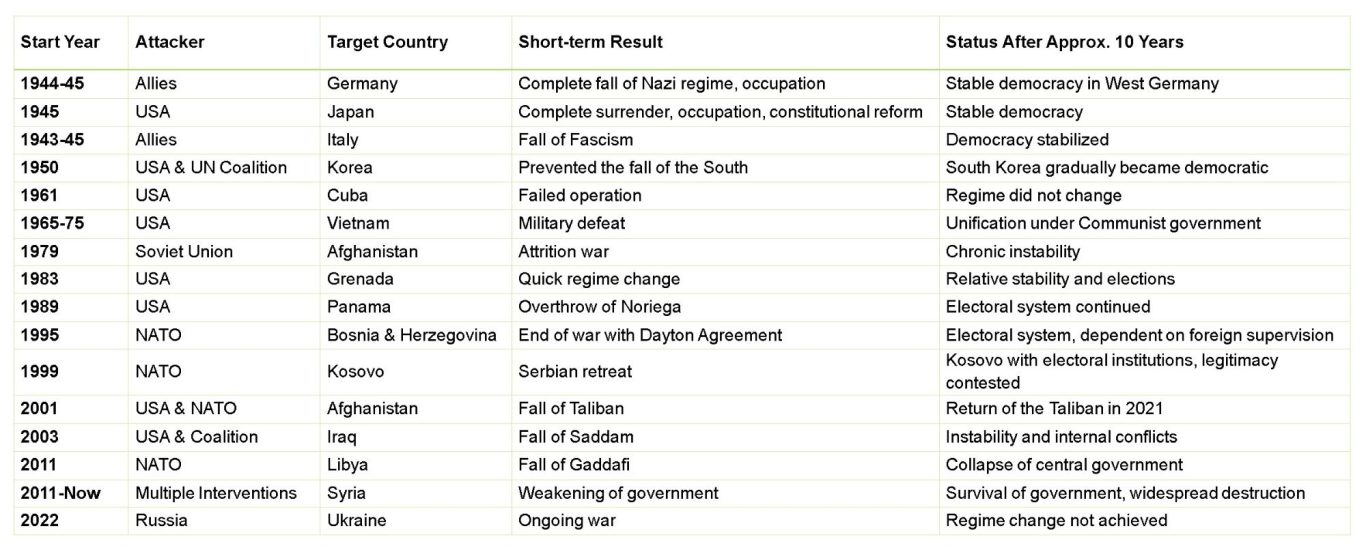
Some cases have had positive long-term results that were much better than the previous situation, such as Germany (only West Germany, of course), Japan, Panama, and Grenada. Conversely, interventions like Iraq, Afghanistan, and Libya have shown that the fall of a government does not necessarily lead to lasting stability, but can create a power vacuum and chronic instability.
I hear very often that "Iran is not Afghanistan or Iraq or Syria." Which is, of course, a correct statement, but the problem is that Iran is not West Germany or Japan either. The important question is which group Iran is structurally closer to. Iran is a country with a high population, vast geographical area, numerous borders, and a complex geopolitical position. Therefore, I decided to compare Iran with the attacked:
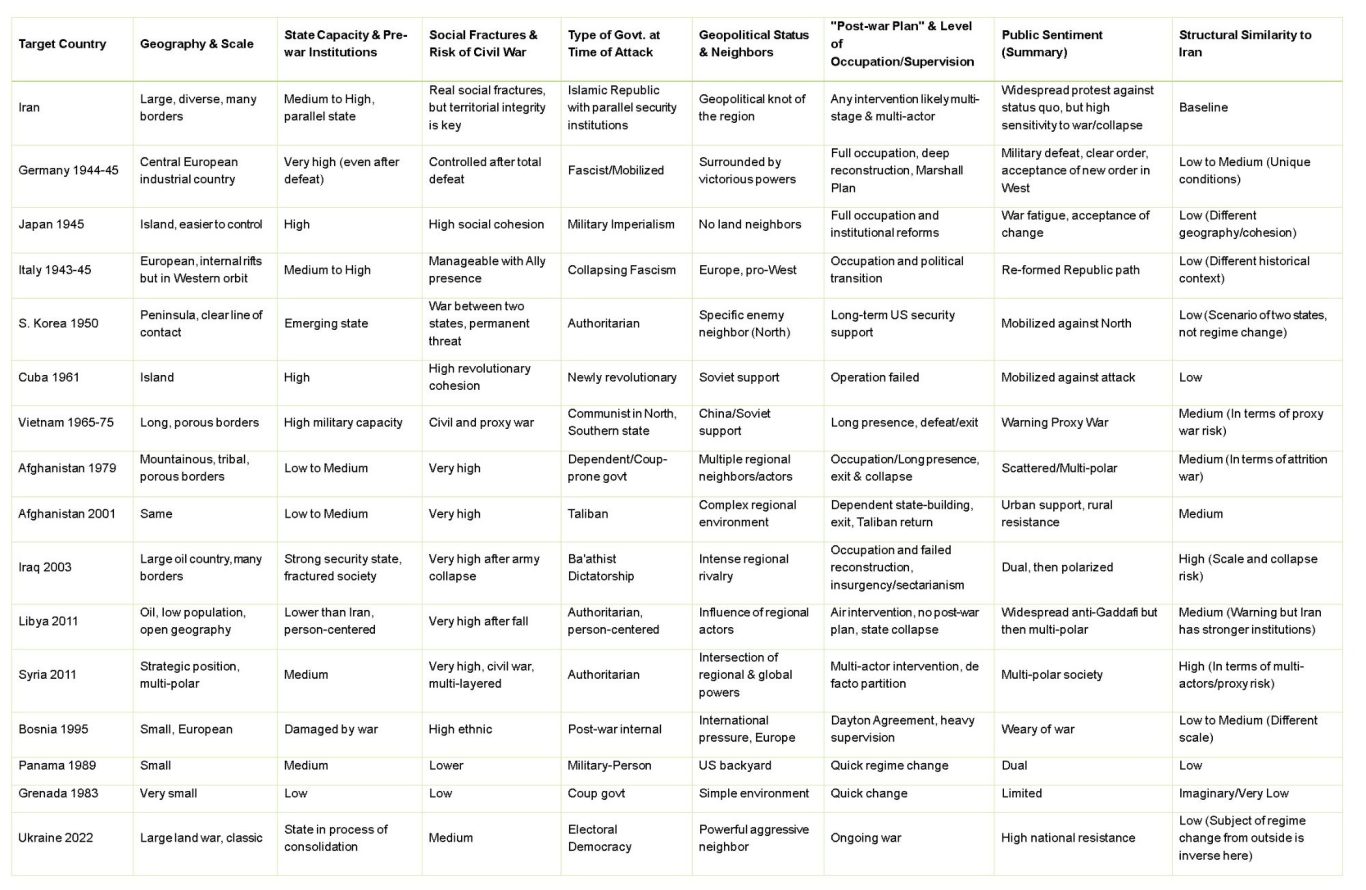
At first glance, Iran’s similarity in terms of energy importance, regional position, and social diversity is closer to Iraq after 2003 or Syria after 2011 than to Germany in 1945. But is it really so? Is Iran like Germany and Japan? Germany and Japan are usually cited as "successful" examples. But there are structural differences between Iran and them:
Germany and Japan both surrendered after a world war and complete military defeat;
the occupation was comprehensive and lasted long-term;
massive economic and institutional reconstruction took place based on the Marshall Plan.
The Cold War international environment favored their reconstruction.
But for today's Iran, a complete military defeat is not a given premise. A nationwide occupation of a country this size has a massive cost. There is no sign of a commitment to a several-hundred-billion-dollar reconstruction. The regional environment is more unstable than post-1945 Europe.
Conversely, is Iran like Iraq?
Like Iraq, Iran is an oil country with high geopolitical importance, has multiple borders and active neighbors, high ethnic and religious diversity, and like Iraq, has a multi-layered security structure. What happened in Iraq was that:
The dissolution of the army and state structure created a power vacuum.
Regional actors—including Iran itself—intervened.
Civil war and Salafism emerged, and the effects still linger today.
Iran is stronger than 2003 Iraq in terms of national cohesion and state institutional capacity, but in terms of the risk of multi-actor regional interference, it bears significant similarity.
Is Iran like Libya?
Gaddafi-era Libya had a person-centered state and weak formal institutions; after the government fell, collapse occurred very rapidly. In contrast, Iran has established formal and parallel institutions, a vast administrative network, and complex infrastructure; consequently, in terms of rapid collapse, it is not like Libya, but in terms of the danger of fragmentation after a power vacuum, it is just as alarming.
Is Iran like Syria?
Similarities include regional nodal position, the simultaneous presence of several regional and global powers, and the possibility of a multi-layered proxy war. Thus, if a power vacuum is created in Iran, the Syrian model (simultaneous entry of foreign actors) is more likely than the German model.
It should be noted that even in a successful model like Germany, the simultaneous entry of foreign actors led to the partitioning of the country—an issue that despite great efforts and West Germany’s economic/political power, still has political, social, and economic effects thirty years after reunification. Unfortunately, Iran is neither 1945 Germany nor the post-2003 Middle East. Therefore, I tried to give quantitative scores to the countries in the table for the indicators above and compare them to Iran. I assumed that, regardless of being positive or negative, Iran's status in each of these indicators gets a full score (5), and other countries are scored in comparison to Iran. Then I calculated the "Average Structural Similarity to Iran."
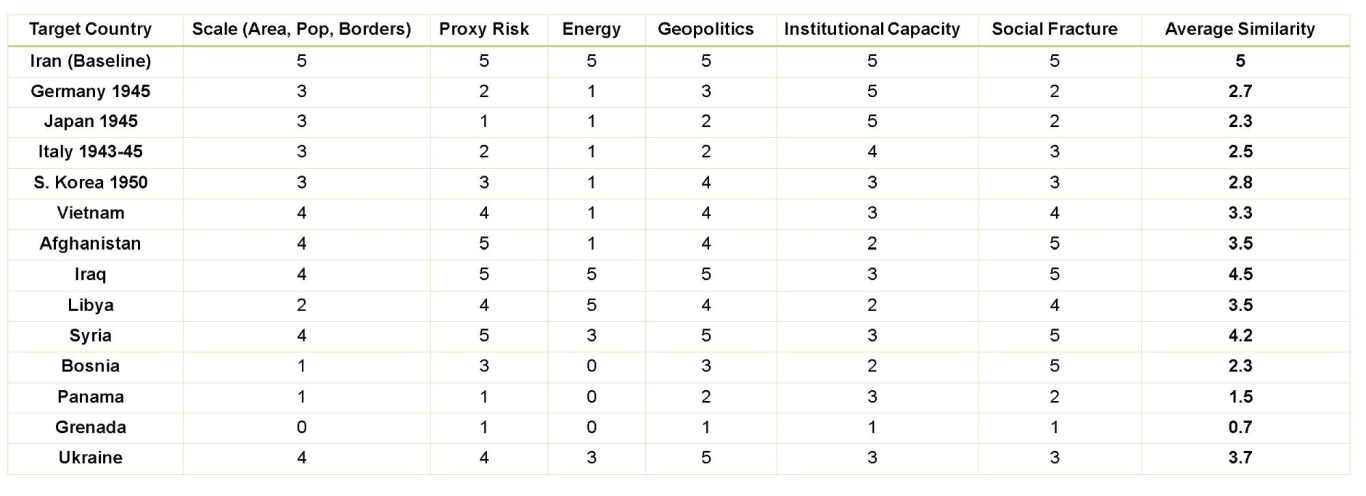
Unfortunately, the fact that today's Iran bears more similarity to unsuccessful and even disastrous examples like Iraq and Syria than to successful and "dreamy" examples like Grenada, Panama, or Japan is undeniable. Simultaneously, I thought that if I only examine similarity and difference in the destination country, the study is incomplete and biased; therefore, I felt it necessary to also examine those who could be effective regarding today's Iran through or by means of a military attack. Otherwise, it is not complete. To be fair and thorough, I separated three layers:
Governments that might play a direct role in an attack scenario.
Regional actors who might be supporters or facilitators.
Non-state actors and political pressure networks.
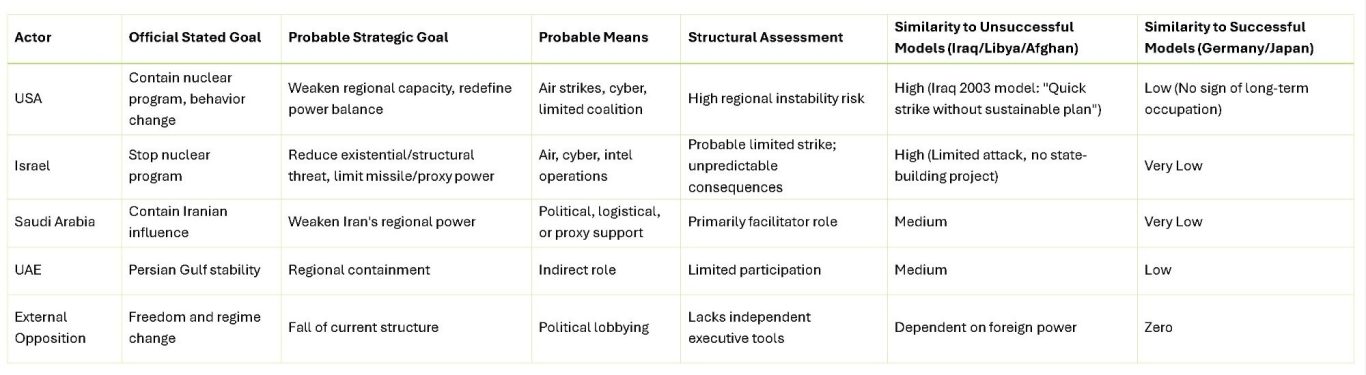
A structural comparison of these actors with successful historical models (Germany, Japan) shows that those two were classic wars between states, not proxies or mere air strikes; they led to the total surrender of the government and nationwide occupation; they were relatively immediately accompanied by massive economic reconstruction; and in the attacking country, there was domestic consensus and long-term commitment for reconstruction.
In today's scenario against Iran, a 1945-style global consensus does not exist; total surrender in the short term is not possible; no grand reconstruction plan has been announced or is even on the agenda; the desire for long-term occupation is very low; and numerous regional actors are present and eager to play a role. Consequently: structural similarity is very low.
In contrast, compared to unsuccessful models, Iran has undeniable similarities to: the Iraq 2003 model (broad goal, dissolution of previous structure, power vacuum, and entry of regional actors); the Libya 2011 model (aerial intervention, lack of post-war plan, internal fragmentation); and the Syria model (multi-actor intervention, long-term proxy war).
Even if the goal of some actors is to remove a structural threat, today's probable tools resemble the "limited strike with uncontrollable consequences" model more than the orderly reconstruction projects of the 20th century. Because:
1. Despite all efforts and lobbying, broad international consensus does not exist.
In 1945, there was complete consensus among the victorious powers (Allies) and the unconditional defeat of the Axis had occurred. But regarding Iran, the UN Security Council is fractured; China and Russia stand against Western consensus on many files. There is no global consensus for the occupation and, more importantly, the reconstruction of Iran. Without consensus, a sustainable reconstruction project is nearly impossible.
2. The cost of occupation in the 21st century vs. the 20th century.
The historical example is Iraq: nearly two decades of conflict, trillion-dollar costs for the US, and massive human casualties for Iraq. After the Iraq and Afghanistan experiences, the US public's desire for long-term occupation has drastically decreased. Without the political will for long-term occupation, the German model cannot be repeated.
3. Iran’s scale and geography.
Iran has nearly 90 million people, is very vast, and shares borders with several active regional countries. Occupying a country of this scale requires hundreds of thousands of troops. There is no sign of preparation for such a project; air or cyber operations are far more likely.
4. Regional multi-player dynamics.
We saw in Iraq and Syria that after the initial strike, regional actors (including Iran itself) entered the country, proxy competition formed, and the war spiraled out of initial control. In Iran’s case, given its geopolitical position, the probability of simultaneous entry by multiple actors is very high; this is the very definition of "uncontrollable consequences."
5. Absence of an announced "reconstruction plan."
In Germany and Japan, systematic economic reconstruction, constitutional reform, and long-term security guarantees were on the agenda; even then, it led to the division of Germany. Conversely, today no official program for a several-hundred-billion-dollar reconstruction of Iran has been proposed; there isn't even a public discussion about post-war administration, and abstract phrases like "by the people's own hands" are used. If a blow is dealt, it is more likely the goal is "weakening," not "reconstruction."
6. Modern tools of war.
Wars today have fundamental differences from 80 years ago. Cyber warfare, precision strikes, limited operations, and hybrid sanctions combined with military blows did not exist in the 1940s. These models usually think of behavior change or weakening, not occupation and nation-building.
Given all this, why do some imagine the 1945 Germany scenario is repeatable? This notion is usually based on seven premises.
First: "The dictatorship falls and society is liberated."
If we simplify the end of WWII, the Nazi regime fell, the structure of suppression was destroyed, German society moved toward democracy, and from this, it is concluded that if an authoritarian regime is toppled, society naturally finds the path to freedom. But in more precise historical analysis, Germany's democratization was not just the product of the fall, but the result of the combination of total military defeat, long occupation, institutional purging, and massive foreign investment.
Second: "Foreign intervention can build a new order."
Some imagine that just as the Allies were able to rebuild Germany, a foreign coalition can rebuild Iran. But 1945 conditions were unique. The World War had ended with consensus among victors, the global economy was being redesigned, and the Cold War competition made Germany's reconstruction a strategic project. Today, in this region, there is no world war, nor fundamentally such a structural consensus.
Third: "International Order."
One hidden premise of those hoping for the "Germany model" is that the international order is still the 1945 order; Whereas that order has collapsed or at least been transformed. Comparison with Germany and Japan is not problematic only because those countries' internal conditions were specific; But also because the 1945 world no longer exists. Any post-war reconstruction project is not just a product of the target country’s status, but a product of the international system's structure. If that structure has changed, the possibility of repeating that experience also changes.
In 1945, the international system was being redefined.
- The US and Soviet Union, as two victorious superpowers, had the power and will to rebuild their spheres of influence.
- The UN was newly established and still had broad moral legitimacy.
- NATO formed later, but it functioned within a coherent bipolar order.
The defeat of Germany and Japan was part of the end of a world war, not the result of a limited operation or regional intervention.
Today, however, the situation is completely different.
- The world is neither bipolar nor a stable unipolar one.
- Competition between the US, China, and Russia has created a multi-polar, fractured system.
- The UN Security Council is practically paralyzed in many crises because great power vetoes prevent consensus.
- NATO is no longer the world's only decisive military actor, and even within it, complete political consensus does not exist.
- The legitimacy of foreign interventions, especially after Iraq 2003, has been severely damaged.
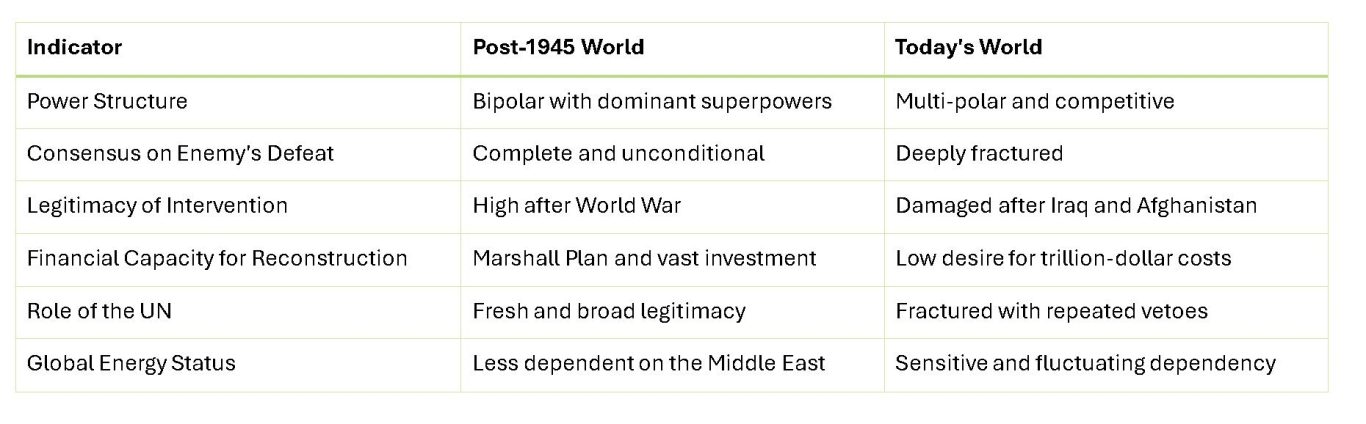
This table shows that even if a country had the exact conditions of Germany, the world no longer has the conditions of 1945. Back then, reconstruction was part of strategic competition between blocs; Today, great powers are themselves involved in direct competition and are less willing to invest long-term in rebuilding a large country in an unstable region.
Also, in the new order, wars occur more in proxy and limited forms. The Ukraine experience shows that even a classic conflict between states quickly becomes a wider field of great power competition. In such an environment, intervention in a country with Iran's geopolitical position most likely leads to a multi-layered proxy competition, not a concentrated reconstruction project. Therefore, comparing Iran to 1945 Germany is misleading not only internally but also in terms of global structure. That experience was possible in the heart of a specific order; an order that no longer exists. If our analysis is to be based on data and history, we must accept that today no power has the 1945 global consensus nor the political desire and capacity for it.
The fourth premise is: "Quick strike, short-term instability, then stability."
In many minds, the scenario looks like this: Limited attack -> government falls -> transition period -> elections.
But in reality, and in the experience of models closer to Iran, we have seen that security collapse can take years; informal armed forces multiply; regional actors enter; and the hypothetical short-term stability often turns into chronic instability.
Conversely, the fifth premise is: "Iran is a more modern society than the failed examples."
This argument is correct in one sense. Iran is stronger than Libya or Afghanistan in terms of human capacity, education, urbanization, and administrative/social institutions. But the decisive point is that Germany's success depended not just on the society being modern, but on complete defeat, comprehensive occupation, and decades of reconstruction. If those three elements don't exist, social similarity alone is not enough.
The sixth premise is: "Society is ready; only the political obstacle must be removed."
This argument claims the people are ready and only the structure of suppression stands in the way. This statement might be part of the reality, but the experience of Iraq and Libya has shown that the sudden removal of the power structure (regardless of the region) can create a power vacuum, and a vacuum does not necessarily lead to democracy.
Against the sixth premise, the seventh premise is: "After the blow, there is a ready figure (Pahlavi) to fill the power vacuum."
The issue is not whether "Pahlavi is good or bad"; the issue is whether he can act as the pillar of transition after a war in terms of political and social mechanisms. The common claim is that Iran "unanimously" wants Pahlavi; therefore, Pahlavi is the "figure of unity," and thus in the vacuum after the war, he can quickly bring order, so the risk of collapse or civil war decreases. I understand why this hope is attractive, but in my view, evidence and political logic do not support it.
Why do I think this premise is politically fragile?
"Unanimity" is a claim, not data.
Even if there is a strong presence on social media and in gatherings inside and outside the country, this does not mean representation of the entire Iranian society. Even if a million people with this mindset take to the streets, they are one million out of ninety million. Iran is pluralistic. Iranian society is a combination of class, generational, ethnic, religious, urban, and non-urban groups. No valid measurement mechanism exists inside the country under conditions of suppression and censorship. Consequently: saying "unanimous" is more of a unificationist narrative than a reliable reality. Additionally, I do not work with absolute statements, because war begins exactly where politics is replaced by absolutism.
Legitimacy is not the same as hypothetical popularity.
Even if Reza Pahlavi is popular among the people, transition legitimacy needs other things: minimal agreement among important political forces, regional and international acceptance without becoming a "puppet project," the ability to manage temporary institutions, security, economy, and the capacity for mediation between rival groups. The main problem for Pahlavi in this scenario is not just his personal ability, but the mechanism of legitimacy. In the post-war atmosphere, any force perceived as close to the attack project will face a legitimacy crisis, even if its intentions are good.
War changes the playing field in favor of armed forces.
After a war or attack, real power usually lies with those who have organizational networks inside the country, control of resources, weapons, local security, or borders, and have executive capability; not just symbolic power (contrary to his and his supporters' claim that his role as Shah/Prince is only symbolic). If a political figure lacks an organizational and executive base inside the country, in the moment of crisis, they either become a political cover for scattered armed forces or are pushed aside by armed and opportunistic actors. This is the same pattern we have seen in many collapses: the symbolic politician becomes the tool or the victim of the field.
Pahlavi is not only the "unity option"; he is also the "polarization option."
The reality is that the name Pahlavi simultaneously has two effects in Iran: for some, it is hope, order, nostalgia, and opposition to the Islamic Republic; but for another segment, it is a reminder of suppression, inequality, SAVAK, political humiliation, or at least a contested historical narrative. So in a crisis scenario, Pahlavi can produce unity, but simultaneously can activate fissures; and in post-war conditions, activating fissures is not just a theoretical discussion; it can become a security issue.
The danger of "conditioning the future on one person."
When a transition project is tied to an individual, several problems arise: if that person is removed from the scene or their credibility is damaged, the whole project collapses. Additionally, other forces feel excluded and move toward radicalization. Most importantly, institution-building and social struggle are delayed because everyone waits for a "savior."
The "Pahlavi fills the vacuum" scenario has two hidden premises.
Those premises are: with war, the government will fall in the short term, and after the war, the country will be manageable. But after an attack, priorities are usually security and control of violence, establishing basic services like water, electricity, and medicine, managing population displacement, controlling armed groups and borders, and preventing proxy interventions. These are the tasks of a provisional government institution, not the work of a "symbol of unity" alone (refer to the transition manual).
Against the claim of Reza Pahlavi lacking legitimacy, the claim of him having legitimacy is also made for reasons like people's response to his calls and his meetings with prominent politicians. I understand the appeal of a very large group of people toward him, but I do not think these claims have real backing. If we want to talk "based on evidence," we must define observable criteria and then compare Pahlavi with examples that were actually recognized by governments as political alternatives. When governments treat an opposition as a "main actor," we usually see at least a few of these signs:
- Official recognition as the head of a provisional government, government in exile, or legitimate representative of the people.
- Transfer of diplomatic representation (accepting an ambassador, official office, or changing the level of relations).
- Relocation of an international seat (like the UN seat).
- Legal and institutional framework (Transitional Council with structure, roadmap, executive team, and union of forces).
- Ability to exert influence inside the country (territorial control, or at least a strong and measurable organizational network).

Based on my observation, the specific evidence regarding "Pahlavi's position" in the eyes of Western and Eastern governments:
1) Interaction exists, but "official recognition" does not.
Pahlavi has meetings and important platforms; this is undeniable, like the meeting with Zelensky on the sidelines of the Munich Security Conference. But these kinds of meetings in foreign policy do not necessarily mean "official representative of the opposition" or "leader of transition"; they mean more of a channel for dialogue and convergence on sanctions and political pressure.
2) Israel has highlighted him, but this too is not "state recognition as an alternative."
An invitation and official hosting in Israel—as the only country with no diplomatic ties to the Iranian government—took place and appeared on the official Israeli government website. But this is substantively different from something like transferring a UN seat (Libya) or official recognition as the head of a provisional government (Venezuela).
3) Even when he himself proposes a "unique role" or "transition," governments do not formalize even that level.
Media reports say Pahlavi considers himself suitable for the transition role, yet doubt about the extent of his domestic base is also prominent in those same reports.
I think the reasons for foreign governments' hesitation in recognizing Pahlavi, based on reports and news, are these:
- The world does not bet on what is not measurable. In cases like Guaidó or the Syrian coalition, governments relied on a legal or institutional framework: parliament, a council, or a recognized coalition. In Iran's case, the claim "the people are calling out unanimously" does not translate into a document at the level of official politics because there is no mechanism for measuring and transferring legitimacy.
- The experience of Iraq and Afghanistan has made governments afraid of creating leaders in exile. After the heavy costs of regime change projects, governments have become much more cautious and usually avoid early recognition of an exiled figure, because if it's a mistake, it has both reputational and security costs.
- Post-war legitimacy. If war or a military attack occurs, any actor perceived as a product or partner of it may face a legitimacy crisis domestically. Governments know this risk; therefore, they usually focus on "political pressure" or "conditional negotiation" rather than "naming a leader."
With all these explanations, it is necessary to emphasize again: first, fundamentally and ethically, I oppose war and foreign attacks. War, regardless of the stated goal, is organized violence that imposes the highest cost on civilians. In all major military interventions after WWII, regardless of the result, destruction of vital infrastructure, mass migration, economic collapse, and social radicalization have been lasting consequences of war. A foreign attack in any form or level—whether it leads to the fall of the government or not—takes many lives, and these many lives are not "war casualties" to me. Regardless of their beliefs, they are humans with biographies, families, and dreams, and all of them are someone's dear one. But I wrote all this to say that my opposition is not based solely on ethics. My opposition to war is based on the conclusion that historical experience shows that the success of regime change through war is very rare and dependent on exceptional conditions. Iran's structure is closer to high-cost examples than to successful ones; the probable tools of today's actors do not align with sustainable reconstruction; and no sign of a ready institutional alternative for managing transition is seen. In such conditions, war is not a calculated risk, but a high-cost gamble with a low probability of success.
I do not deny the anger and despair. But based on historical evidence and the review of numerous analyses during this forty-day opportunity, a war against Iran would likely be a more costly and destabilizing path. For this reason, my position is opposition to it; not just out of emotion and ethics, but out of responsibility toward the data and their (un)predictable consequences.