English version
War, Oil, and the Persian Gulf
A technical review of supply chains, refinery limits, and why disruption spreads far beyond the battlefield
Introduction
Over the past weeks I have found myself following discussions about war, escalation, and regional security with a particular kind of unease. Not only as someone who grew up in Iran, but also as someone whose professional life revolves around the technical systems that quietly underpin the global energy economy.
As many of you may know, my background is in process engineering, working with petroleum processing systems. Most of my daily work has nothing to do with geopolitics. It involves process design, refinery operations, and the practical constraints of industrial plants that transform crude oil into usable fuels. But precisely because of that background, it is difficult to watch the current situation without thinking about the technical side of the system that is rarely discussed in public debates. So I figured I would use my knowledge on the matter and write this, which would also help me to avoid checking war news every five minutes.
The global oil market is often described as if it were a simple trading network where barrels can easily be redirected from one supplier to another. In reality it is a tightly interconnected chain of reservoirs, pipelines, tankers, refineries, and specialized industrial processes. When that chain is disrupted, especially in a region as central as the Persian Gulf, the consequences can extend far beyond the immediate conflict.
This text is therefore not a political statement and does not attempt to take a position on the actors involved in the current war. It is simply a technical review of how the oil supply chain works and what its structural limits are. The aim is to explain, in clear and accessible terms, why disruptions in the Persian Gulf can matter so much for the global energy system and why those effects can eventually reach far beyond the region itself.
Understanding these mechanics does not explain the politics of war. But it does help explain how the infrastructure of energy can quietly shape the scale, duration, and economic consequences of a conflict.
1. Oil Supply Chain
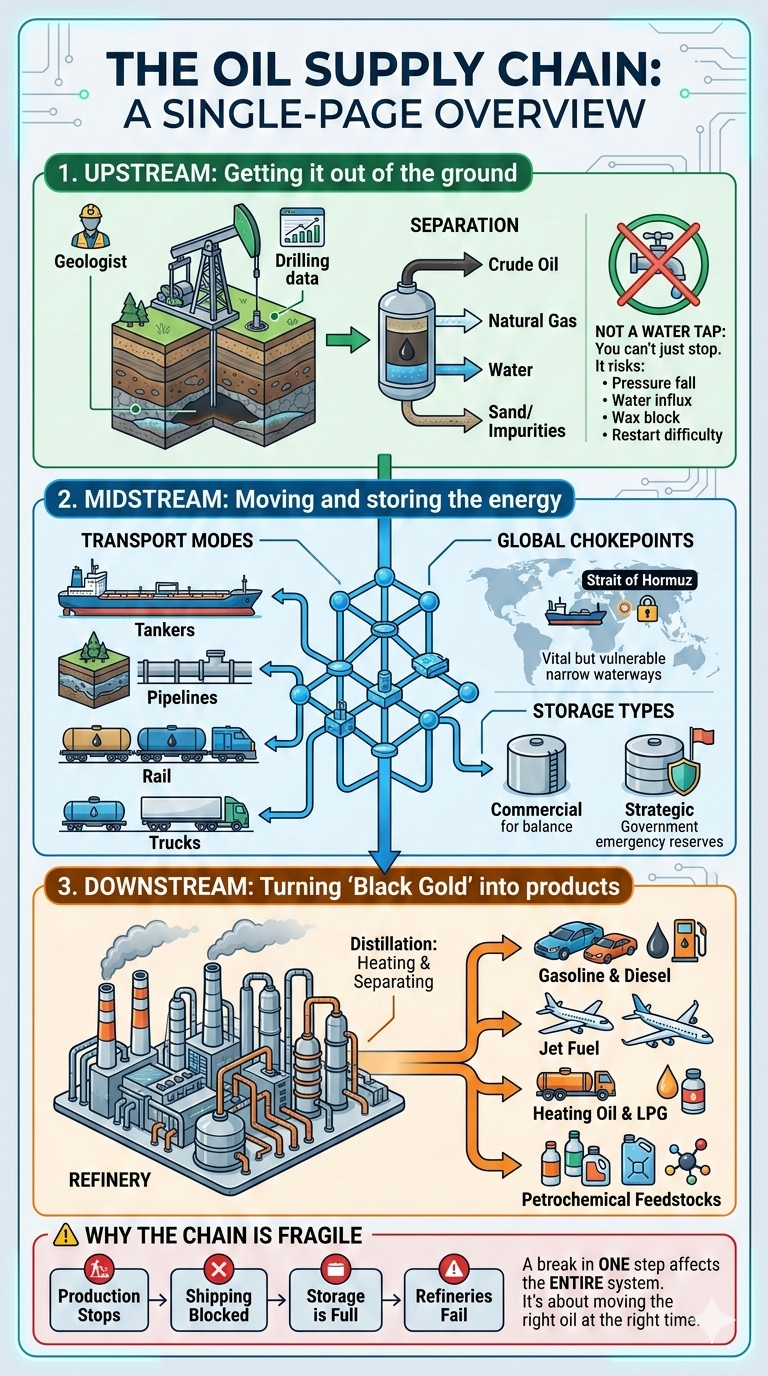
The oil supply chain has three big parts. People in the oil industry often divide the system into three sections:
- Upstream
- Midstream
- Downstream
These words sound technical, but the idea behind them is simple.
Upstream means: getting oil out of the ground
This is the beginning of the story. Oil is buried deep underground in rock formations. Companies first have to find it. They do that with geology, seismic studies, drilling data, and a lot of expensive exploration work. Once they know where the oil is, they drill wells into the reservoir. Then the oil comes up to the surface. But even here, the picture is more complicated than most people imagine. What comes out of a well is often not just clean oil. It can be a mixture of:
- crude oil
- natural gas
- water
- sand or other impurities
So the first step after production is usually separation and basic treatment.
This is why oil production is already an industrial process long before the oil reaches a ship or a refinery.
An oil well is not like a water tap. This point is extremely important, and it is one of the biggest misunderstandings in public discussions. Many people imagine that oil production works like this: if you want oil, you open the tap; if you do not want oil, you close it; then later you open it again and continue as before. Real oil fields do not behave so simply.
An oil reservoir is a natural underground system with pressure, fluids, rock pores, gas, and often water. Production depends on the balance inside that reservoir. When oil is being produced, pressure changes. When production is stopped, other things can also change.
For example:
- pressure in the reservoir can fall
- water can move into places where you do not want it
- gas can expand in ways that reduce future oil production
- wax or heavy components can block flow paths
- the well itself can become harder to restart
This does not mean every short shutdown destroys a field. Some reservoirs can handle temporary shut-downs quite well. But it does mean that oil production is not infinitely flexible.
So when people say, “Why don’t they just stop production for a while and restart later?”, the answer is that in some cases that can damage the reservoir, reduce long-term production, or create major technical and economic problems. That is why production decisions in oil fields are usually made very carefully.
Midstream means: moving and storing oil. Once the oil has been produced, it has to travel. This is the middle part of the chain. Oil can be moved in several ways:
- pipelines
- tanker ships
- sometimes rail
- in smaller cases trucks
For global trade, tanker shipping is extremely important. A large share of the world’s oil moves across the sea. That means geography matters a great deal. Some places on the map become chokepoints, locations where huge amounts of oil must pass through narrow routes. If one of these routes is threatened, delayed, or blocked, the effects can be felt across the entire global economy.
One of the most important of these chokepoints lies at the entrance of the Persian Gulf.
Strait of Hormuz
A significant portion of the world’s traded oil passes through this narrow waterway connecting the Persian Gulf to the open ocean.
Oil also has to be stored. There are two main kinds of storage.
Commercial storage
This is the ordinary storage used by companies during normal business operations. It helps balance daily flows between production, shipping, refining, and sales.
Strategic storage
This is emergency storage maintained by governments, especially in large importing countries. These reserves exist for crises such as wars, sanctions, or major supply disruptions.
Strategic reserves are important, but they cannot permanently replace a large missing supply. They are designed mainly to buy time.
Downstream means: turning crude oil into useful products. Crude oil by itself is not very useful for everyday life. People do not put crude oil directly into cars or airplanes. First it must go to a refinery.
A refinery is a large industrial facility that heats, separates, treats, and converts crude oil into many different products such as:
Gasoline, diesel, jet fuel (Yeah even those fancy fighter jets and bombers depend on oil), heating oil, liquefied petroleum gas, petrochemical feedstocks
The first major step in a refinery is usually distillation. This means heating crude oil and separating it into different fractions based on boiling temperatures. But that is only the beginning. Modern refineries also use many additional processes that chemically transform heavier fractions into more valuable lighter fuels.
So the refinery is not just a place where oil is cleaned. It is a complex conversion system.
Why the whole chain is fragile? So we learnt that the oil system is not a single movement from seller to buyer. It is a chain with many links:
- exploration
- production
- field treatment
- transport to export terminals
- shipping or pipeline transport
- storage
- refining
- product distribution
If something goes wrong in just one of these steps, the problem can spread.
For example:
If production stops, there is less crude oil available.
If shipping is disrupted, oil may exist but cannot reach buyers.
If storage is full, producers may have to slow production.
If refineries cannot process the available crude, supply problems remain even when oil is physically present.
So an oil crisis is not only about how much oil exists in the world. It is also about whether the right oil can move through the system at the right time.
2. Why Not All Oil Can Easily Be Replaced
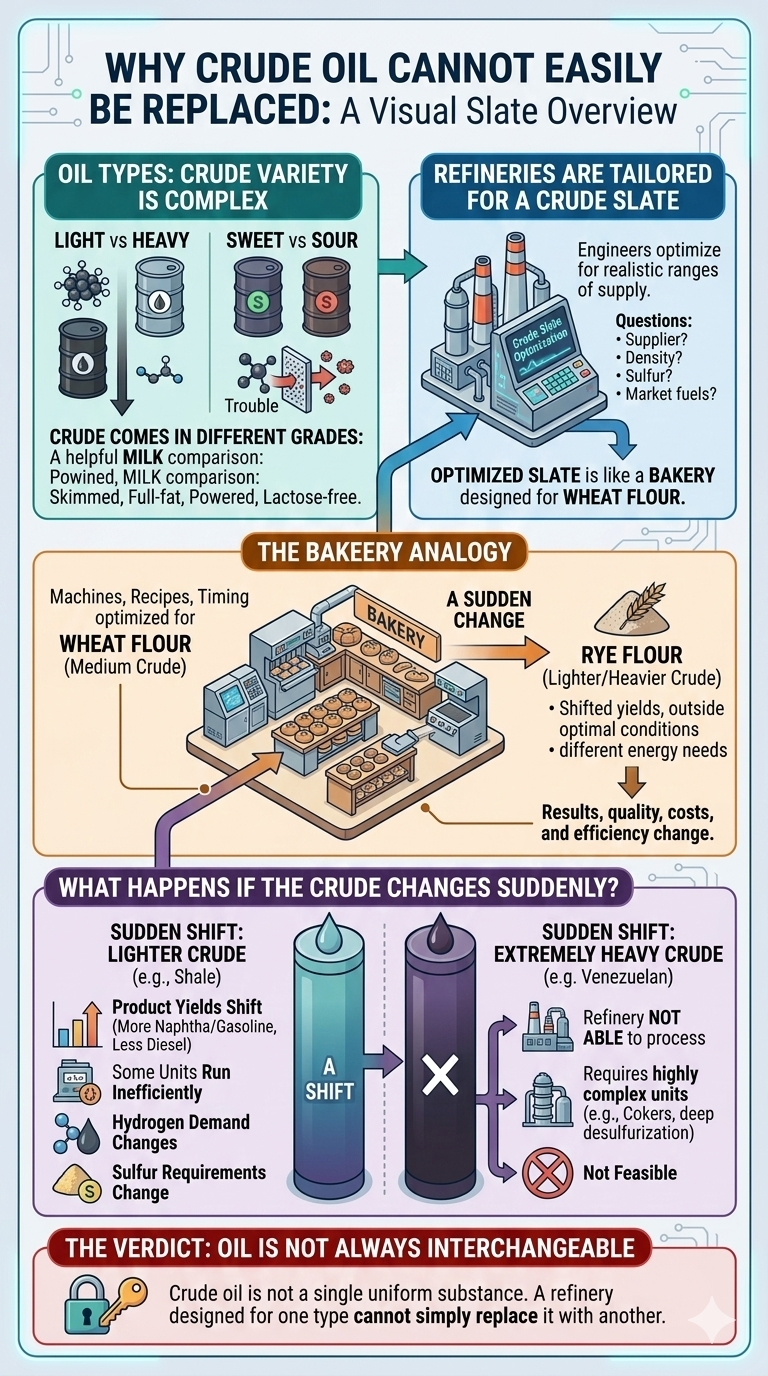
This is the second major misunderstanding in most public discussions. People often speak about oil as if it were a single uniform substance. The idea is simple: if one country stops exporting oil, buyers can just purchase it from somewhere else. But crude oil is not a single uniform substance. Different crude oils behave very differently in refineries.
A helpful comparison is milk. When someone says “milk”, it sounds simple. But milk can be skimmed, full-fat, powdered, fermented, or lactose-free. They are all milk, yet they behave differently in cooking and industry.
Crude oil is far more varied.
Crude oil comes in different types
Two common ways to describe crude oil are:
- light or heavy
- sweet or sour
Light vs heavy
ight crude is less dense and usually contains more smaller hydrocarbon molecules that are easier to convert into products like gasoline and naphtha. Because of this, light crudes are often priced higher than heavy crudes, although the exact value depends on refinery configuration and market conditions.
Heavy crude contains larger molecules that require more complex refining processes. Because of the additional processing required, heavy crude often trades at a discount compared to lighter grades.
Sweet vs sour
This refers to sulfur content. So generally we can assume sulfur is trouble (generally not always). Sweet crude contains little sulfur. Sour crude contains more sulfur.
Sulfur must be removed to meet fuel standards. Removing it requires hydrogen, energy, and specialized equipment.
Refineries are designed for certain oils. When engineers like me design a refinery, they do not plan for every possible crude oil on Earth. Instead they plan for a realistic range of crude oils the refinery will likely process.
Engineers ask questions such as: Which suppliers will provide crude oil? How heavy will the crude be? How much sulfur will it contain? What fuel products are most important for the market?
The expected mix of crude oils is often called the crude slate. A refinery is optimized for that slate.
So what happens if the crude suddenly changes? Imagine a bakery designed to work with wheat flour. All the machines, recipes, and timing are optimized for that flour. If the bakery suddenly receives a very different flour, it can still bake bread, but the results, quality, costs, and efficiency will change. Refineries behave similarly.
If a refinery designed for medium-sulfur crude from the Persian Gulf suddenly runs much lighter crude from another region, so as we said even more expensive, should be great, right? No let me explain. Several things can change:
- product yields shift
- some process units operate outside optimal conditions
- hydrogen demand changes
- sulfur removal requirements change
The refinery can usually adapt within limits, but the change is rarely perfect.
So in that case we take heavy sour crude, it's even cheaper! Well not quite feasible. If a refinery designed for medium-sulfur crude from the Persian Gulf suddenly receives extremely heavy and sulfur-rich crude from a region such as Venezuela (I bet Trump doesn't know this), the refinery may not be able to run it at all without blending or major adjustments. Heavy Venezuelan crude requires highly complex refining units such as cokers and deep desulfurization systems, that many refineries optimized for medium crude do not possess. In such cases, the crude cannot simply replace the original supply.
So crude oil is not always easily interchangeable.
3. Why Some Refineries Can Handle Heavy Oil and Others Cannot?
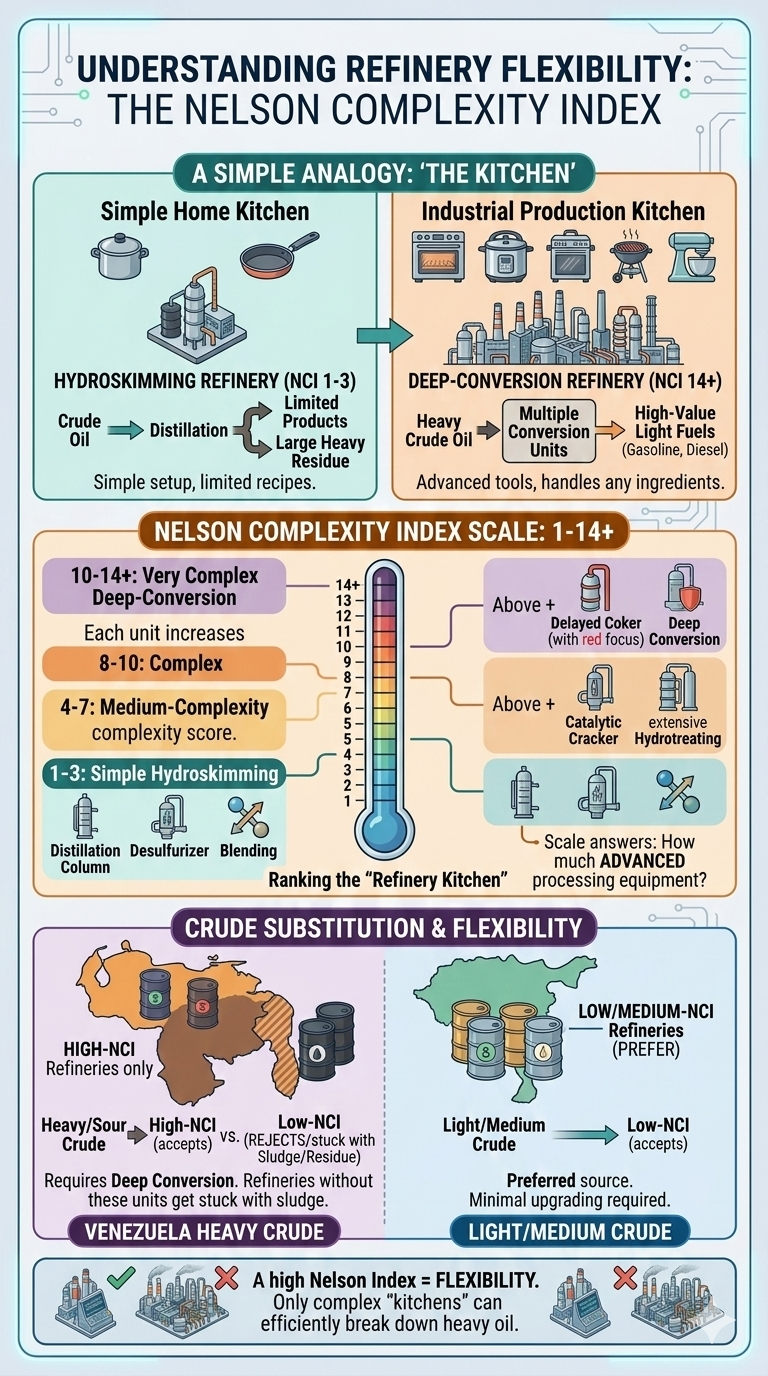
A useful way to understand refinery flexibility is a measure called the Nelson Complexity Index. This index was developed in the 1960s by the American engineer Wilbur L. Nelson to compare how technologically complex different refineries are.
In simple terms, the index answers one question: How much advanced processing equipment does a refinery have compared to a very simple refinery?
The idea behind the index
The simplest type of refinery is called a hydroskimming refinery. It mainly performs basic operations such as:
- distillation
- simple desulfurization
- blending
A refinery like this can separate crude oil into fractions, but it has very limited ability to transform heavy molecules into lighter products.
In the Nelson index system, this simple refinery is assigned a value of about 1 or 2.
More advanced refineries add additional conversion units, for example:
- catalytic crackers
- hydrocrackers
- delayed cokers
- reformers
- extensive hydrotreating systems
Each additional processing unit increases the refinery’s complexity score. The more of these units a refinery has, the higher its Nelson Complexity Index.
What the numbers roughly mean
While exact numbers vary, the scale typically looks like this:
Nelson Index 1–3: Simple hydroskimming refinery
Nelson Index 4–7: Medium-complexity refinery
Nelson Index 8–10: Complex refinery
Nelson Index 10–14+: Very complex deep-conversion refinery
Highly complex refineries can break down heavy oil molecules and convert them into lighter fuels like gasoline and diesel. Simple refineries cannot do this efficiently.
Why this matters for crude substitution
This is where the connection to crude oil quality becomes important. Heavy and high-sulfur crude oils require deep conversion processes. Without those units, a refinery would end up with large amounts of heavy residue that it cannot easily sell. That is why very heavy crude oils from places like Venezuela are usually processed in refineries with high complexity scores. Refineries with a lower Nelson index often prefer medium or lighter crude oils, because these produce more usable fuels without requiring heavy upgrading.
A simple analogy
Think of two kitchens.
One kitchen only has:
- a stove
- a pot
- a frying pan
The other kitchen has:
- ovens
- pressure cookers
- grills
- mixers
- industrial equipment
Both kitchens can cook food.
But the second kitchen can prepare a much wider range of ingredients and recipes.
Refineries work in a similar way. The Nelson Complexity Index measures how advanced the “kitchen” is.
4.The role of Persian Gulf crude
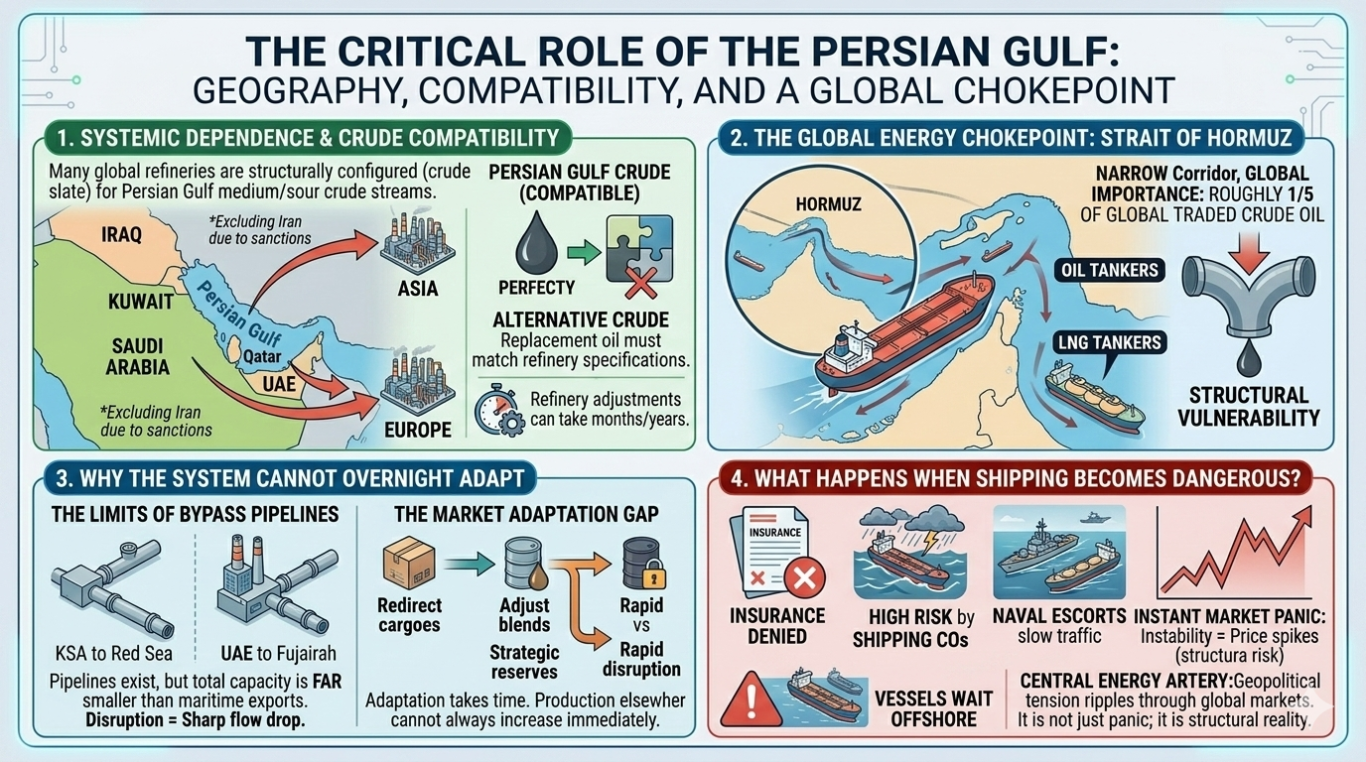
Many refineries in Asia and parts of Europe were built with the expectation that they would process crude oils exported from the Persian Gulf.
Major exporters from the Persian Gulf include countries such as: Saudi Arabia, Iraq, Kuwait, the United Arab Emirates, Qatar. We don’t talk about Iran's crude as this one is officially under sanctions now since many years.
Over decades, supply relationships and refinery configurations developed around these crude streams. This means that the importance of Persian Gulf oil is not only about volume. It is also about compatibility with existing refining systems.
These crudes fit well within the operating window of many refineries. If that supply is suddenly disrupted, the world cannot simply replace it with any other crude oil available on the market. The replacement oil must also be compatible with the existing refinery system.
This is one of the reasons why disruptions affecting the Persian Gulf can have consequences far beyond the region itself.
Why the market cannot adapt overnight? Markets do have ways to adapt:
- redirect cargoes
- adjust refinery blends
- release strategic reserves
- increase prices to reduce demand
But each of these responses takes time.
Production elsewhere cannot always increase immediately. Refinery adjustments are operationally complex need sometimes months and years. Strategic reserves are temporary.
So when supply from the Persian Gulf is disrupted, the world cannot instantly replace it. Markets adjust, but they adjust slowly and often painfully.
Why Geography Matters: The Persian Gulf and a Global Energy Chokepoint
Oil does not only depend on geology and engineering. It also depends on geography. Even if oil is produced successfully and refineries are ready to process it, the oil sill has to travel from producer to consumer. In the global oil system, much of that movement happens across the ocean. This is where geography becomes critically important.
Some parts of the world function as chokepoints like narrow passages where enormous volumes of oil must pass through. If one of these chokepoints becomes dangerous, blocked, or unstable, the consequences can reach far beyond the region itself.
Many refineries around the world were designed to process medium and sour crude oils exported from the Persian Gulf. One of the most important chokepoints in the entire global energy system lies at the entrance of the Persian Gulf: Strait of Hormuz
A narrow passage with global importance
The Strait of Hormuz is not a large body of water. At its narrowest navigable shipping lanes, it is only a few kilometers wide. Yet through this narrow corridor flows a massive share of the world’s traded energy. Roughly one fifth of globally traded crude oil passes through this strait. In addition to crude oil, large volumes of liquefied natural gas (LNG) also leave the Persian Gulf through the same route.
From a systems perspective, this creates a structural vulnerability: a large part of the world’s energy supply depends on a single maritime passage.
Why so much oil passes through this region?
The reason is simple: geography and geology happened to concentrate some of the world’s largest oil reserves around the Persian Gulf. As we said, several of the world’s major oil producers export large portions of their crude through this region. For many of these countries, the most practical export route is through the Persian Gulf and out through the Strait of Hormuz.
That means that even if the oil fields themselves are operating normally, the oil cannot reach the global market without passing through this narrow corridor.
Why the system cannot easily bypass the strait?
In theory, countries could avoid the Strait of Hormuz by using pipelines that transport oil to other ports. In practice, this option is limited.
Some pipelines do exist. For example, Saudi Arabia operates pipelines that move oil to ports on the Red Sea, and the United Arab Emirates has a pipeline that bypasses the Strait of Hormuz by exporting crude from the port of Fujairah.
But the capacity of these alternative routes is far smaller than the total volume normally exported from the Persian Gulf. This means that if maritime traffic through the strait were severely disrupted, only a portion of the normal exports could be rerouted through pipelines.
The rest would simply not reach the market.
What happens when shipping becomes dangerous?
A chokepoint does not need to be physically blocked to create a crisis. Sometimes the system breaks down for other reasons. For example:
- insurance companies may refuse to cover ships in a war zone
- shipping companies may decide the risk is too high
- naval escorts may be required, slowing traffic
- vessels may wait offshore until the situation becomes clearer
Even if a few tankers continue to pass through, the overall flow of oil can drop sharply. From the perspective of the global oil market, what matters is not whether the passage is technically open, but whether oil can move through it reliably and continuously.
Why markets usually react quickly to threats in this region?
Because such a large share of global energy flows through the Persian Gulf, markets are extremely sensitive to instability there. Even rumors of disruptions can cause price spikes. This reaction is not simply panic. It reflects a real structural risk.
If large volumes of oil cannot leave the Persian Gulf for even a short period of time, several things can happen quickly:
- refineries begin to worry about supply shortages
- traders compete for alternative crude shipments
- shipping costs and insurance premiums rise
- governments consider releasing strategic reserves
The global oil system is large, but it is also tightly interconnected. When one of its central arteries is threatened, the entire system feels the pressure.
Why this matters in times of war?
During periods of geopolitical tension or military conflict, the Persian Gulf becomes one of the most sensitive regions in the global energy system. A war in this region does not only threaten individual oil fields or ports. It can threaten the entire movement of energy between producing regions and consuming economies. And because the oil supply chain from production to refining cannot adjust instantly as we learned above, disruptions in the Persian Gulf can quickly ripple through global markets.
This is why analysts often describe the region not only as a center of oil production, but also as one of the strategic fault lines of the global energy system.
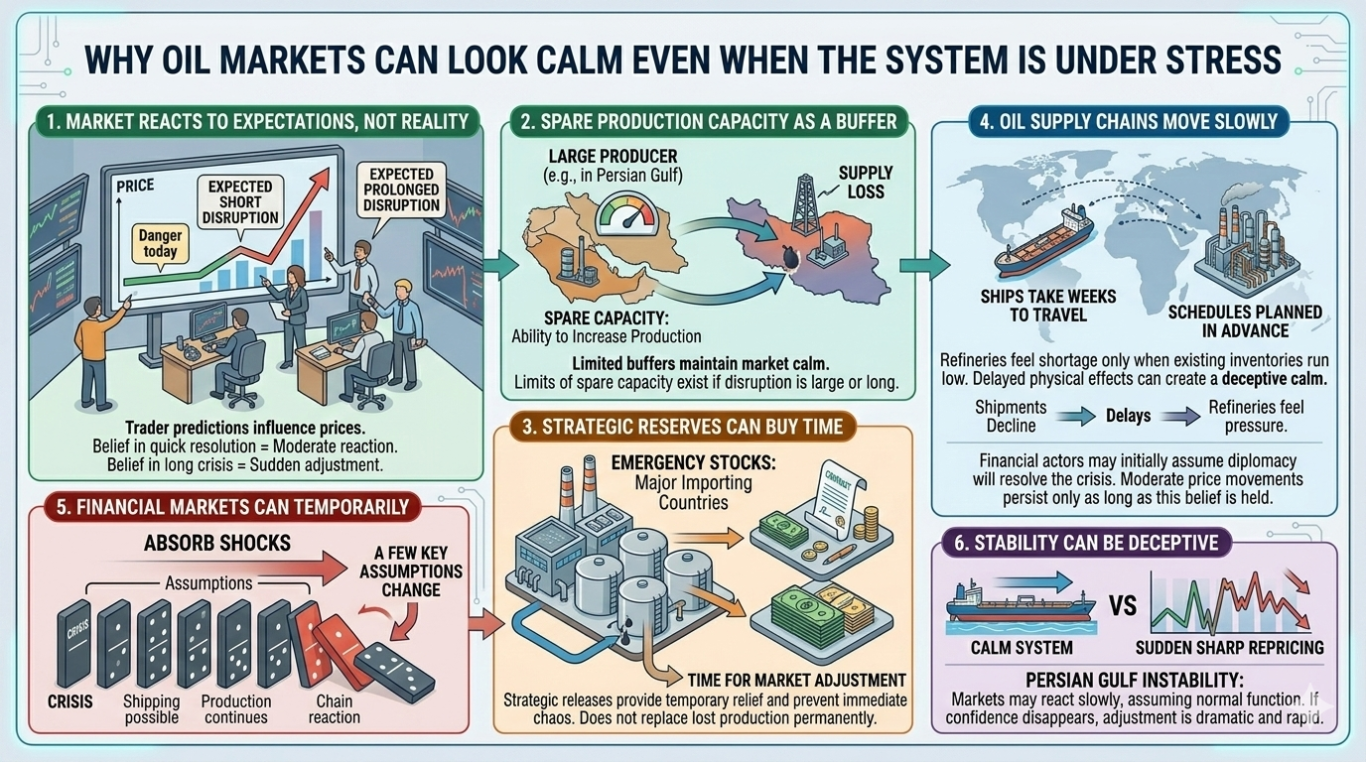
5. Why Oil Markets Can Look Calm Even When the System Is Under Stress
So I said a conflict in Persian Gulf can quickly affect the whole market, but why we don’t see it yet?
One of the most puzzling aspects of energy crises is that the oil market does not always react immediately to geopolitical danger. Wars can begin, shipping routes can become risky, and yet oil prices may remain relatively stable for some time. To many observers this seems strange. If such a large part of the global oil system is under threat, why does the market not immediately collapse into chaos?
The answer lies in how the oil market actually works. Prices are not determined only by physical oil flows. They are also influenced by expectations, inventories, spare capacity, and financial markets.
Oil markets react to expectations, not only reality
Oil prices are largely determined in global trading markets. In these markets, traders constantly try to predict what supply and demand will look like in the near future.
This means the market is reacting not only to what is happening today, but also to what participants believe will happen tomorrow.
If traders believe that a disruption will be short-lived, they may expect supply to recover quickly. In that case, prices may rise only slightly, even if the situation looks dangerous.
But if traders begin to believe that a disruption could last for months, prices can move very rapidly.
In other words, the oil market is not simply reacting to events. It is reacting to expectations about future events.
Spare production capacity acts as a buffer
Another reason the market sometimes appears calm is the existence of spare production capacity. Of course this conflicts are predictable so some oil-producing countries maintain the ability to increase production if they feel it would be needed. In the past, this role has often been played by large producers in the Persian Gulf.
If traders believe that additional production can quickly compensate for a supply loss, they may expect the system to stabilize. However, spare capacity has limits. If a disruption becomes large or long enough, even these buffers may not be sufficient.
Strategic reserves can buy time
Many major oil-importing countries maintain emergency oil stocks. These reserves were created after the oil crises of the 1970s, when governments realized how vulnerable modern economies were to supply disruptions.
governments of importing countries can release oil from strategic reserves to stabilize markets. Strategic reserves do not replace lost production permanently, but they can reduce panic and buy time while markets adjust.
Oil supply chains move slowly
Another important factor is time. The global oil system does not respond instantly to shocks. Ships take weeks to travel between regions. Refinery schedules are planned in advance. Cargoes are often sold months ahead. Because of this, the physical effects of a disruption may appear only after some delay.
For example, if shipments from a region suddenly decline, refineries in distant countries may not feel the shortage until their existing inventories begin to run low.
This delay can create the impression that the system is stable, even though pressure is slowly building.
Financial markets can temporarily absorb shocks
Modern oil markets are highly financialized. Futures contracts, derivatives, and speculative trading all play a role in price formation. Financial actors may initially assume that a crisis will be resolved quickly through diplomacy or military de-escalation.
As long as this belief persists, price movements may remain relatively moderate. But if confidence disappears and the market begins to expect a prolonged disruption, the adjustment can be sudden and dramatic.
Stability can sometimes be deceptive
For all these reasons, oil markets can appear stable even when underlying risks are increasing. The system may continue operating normally for a time. Tankers still move, refineries continue processing crude, and inventories help cushion the impact.
But this apparent stability can be fragile.
If a few key assumptions change, such as the expectation that shipping will remain possible, or that production will continue uninterrupted, the market can reprice risk very quickly.
In those moments, price movements are often sharp and rapid.
Why this matters in the Persian Gulf
Because such a large share of the world’s energy system is connected to the Persian Gulf, instability in this region always carries the potential for global consequences. Yet markets may initially behave as if the system will continue functioning normally. This is why observers sometimes see a strange contrast: rising geopolitical tension in the Persian Gulf, while oil prices remain relatively calm.
The calm does not necessarily mean the risk is small. Sometimes it simply means the market is still assuming that the system will continue to function. And if that assumption changes, the adjustment can come very quickly.
6. What Happens If Oil Exports from the Persian Gulf Are Really Disrupted
Understanding the oil supply chain helps explain why disruptions in the Persian Gulf are taken so seriously in global energy markets. But the most important question remains practical:
What would actually happen if large volumes of oil could no longer leave the Persian Gulf for several weeks or months?
The consequences would not appear everywhere at the same time. The effects would spread through the system step by step.
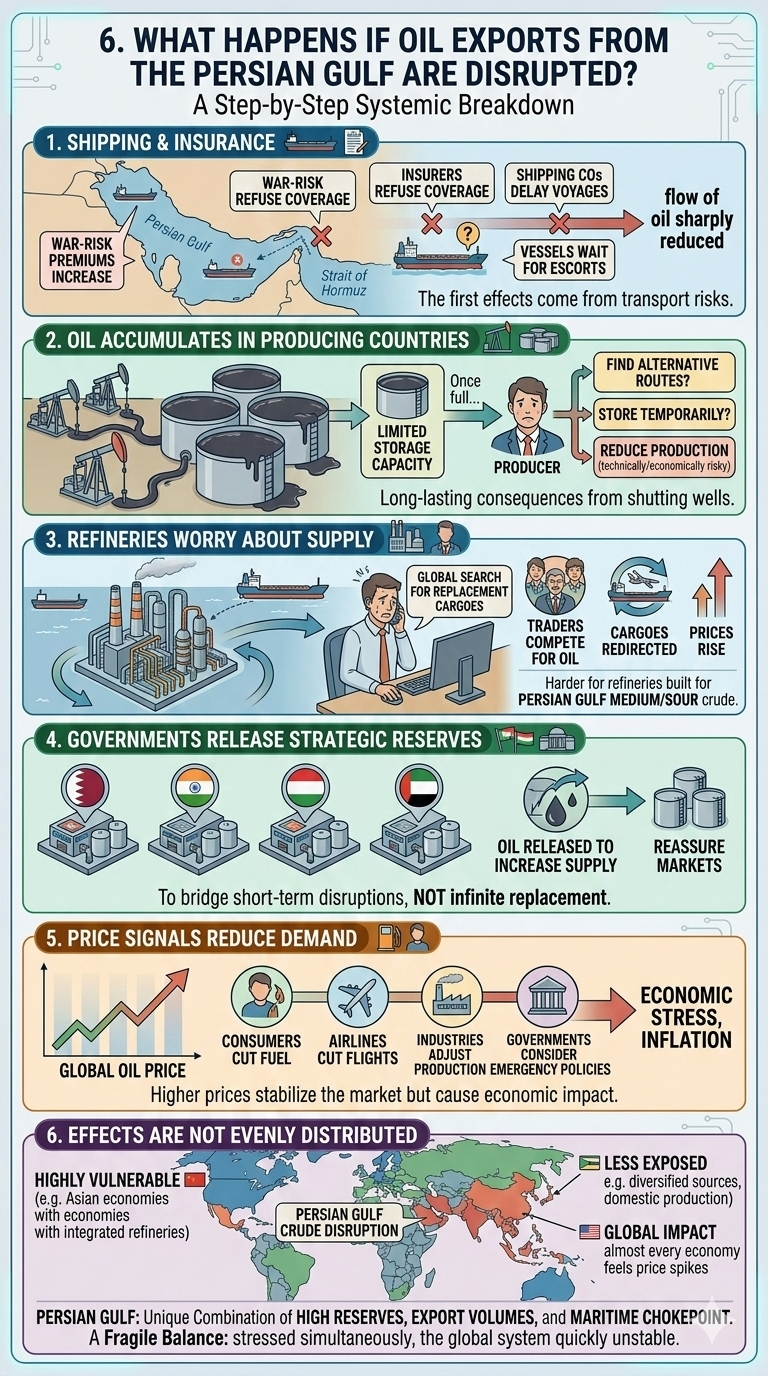
The first effects appear in shipping and insurance
In many crises the first disruption does not come from physical destruction of oil fields or terminals. Instead it comes from the risks associated with transportation.
When a region becomes dangerous for shipping, several things can happen:
- insurance companies increase war-risk premiums
- some insurers refuse to cover ships entirely
- shipping companies delay voyages
- vessels wait outside the region for military escorts
Even if the shipping route remains technically open, these changes can sharply reduce the number of ships willing to enter the area.
The result is a sudden slowdown in the flow of oil. From the perspective of the global oil system, this is already a major disruption.
Oil begins to accumulate in producing countries
If tankers cannot load or leave ports normally, oil production does not immediately stop. Oil continues to flow from wells into gathering systems, storage tanks, and export terminals.
But storage capacity is limited. Once storage facilities begin to fill, producers face difficult decisions. They must either find alternative transport routes, store oil temporarily, or reduce production. Reducing production can be technically and economically risky, especially if the shutdown is prolonged.
This is another reason why disruptions in export routes can have long-lasting consequences.
Refineries begin to worry about supply
While oil accumulates in producing regions, refineries in importing countries start to face the opposite problem. Refineries normally operate with planned deliveries of crude oil. Tankers are scheduled weeks in advance, and refineries maintain limited inventories.
If shipments are delayed or cancelled, refinery operators begin searching for replacement cargoes. At this stage several things usually happen:
- traders compete for available crude oil
- cargoes are redirected from other markets
- prices begin to rise
The situation becomes especially difficult when the missing crude oil has specific characteristics that many refineries depend on, such as the medium and sour grades exported from the Persian Gulf.
Strategic reserves may be released
If governments believe that supply disruptions could become serious, they may decide to release oil from strategic reserves. These reserves are designed specifically for situations like wars or major supply interruptions. A coordinated release can temporarily increase available supply and reassure markets.
However, strategic reserves are finite. They are intended to bridge short-term disruptions, not to replace a major exporting region indefinitely.
Price signals begin to reduce demand
One of the main ways markets balance supply and demand is through price. If supply falls while demand remains constant, prices rise. Higher prices then begin to change behavior throughout the economy:
- consumers reduce fuel consumption
- airlines cut flights or increase ticket prices
- industries adjust production
- governments consider emergency policies
This process helps reduce demand and stabilize the market, but it also creates economic stress. Energy price spikes can contribute to inflation, slower economic growth, and political pressure in many countries.
The effects are not evenly distributed
Not all countries experience the impact of an oil disruption in the same way. Countries that import large volumes of crude oil from the Persian Gulf are especially vulnerable. These include several major Asian economies whose refineries are closely integrated with oil supplies from this region. Other countries with more diversified supply sources, large domestic production, or significant strategic reserves may be somewhat less exposed.
Even so, a large disruption in the Persian Gulf would affect global oil prices, meaning that almost every economy would feel some impact.
Why the Persian Gulf remains central to the global oil system
The global oil market has changed in many ways over the past decades. New production regions have emerged, and technology has improved. But the Persian Gulf still occupies a unique position.
The region combines three factors rarely found together elsewhere:
- very large oil reserves
- high export volumes
- a shared maritime exit through a narrow chokepoint
Because of this combination, disruptions affecting the Persian Gulf can quickly move from being a regional problem to becoming a global energy challenge.
A fragile balance
For much of the time, the global oil system functions smoothly. Oil fields produce, tankers move across oceans, refineries operate continuously, and fuel reaches consumers around the world. But this stability depends on a delicate balance. If several parts of the system are stressed at the same time (production risks, shipping disruptions, geopolitical tensions, and market uncertainty) the system can become unstable.
When that happens, adjustments in supply and demand can occur very quickly, often accompanied by sharp movements in prices.
7. How Oil Supply Can Shape a War
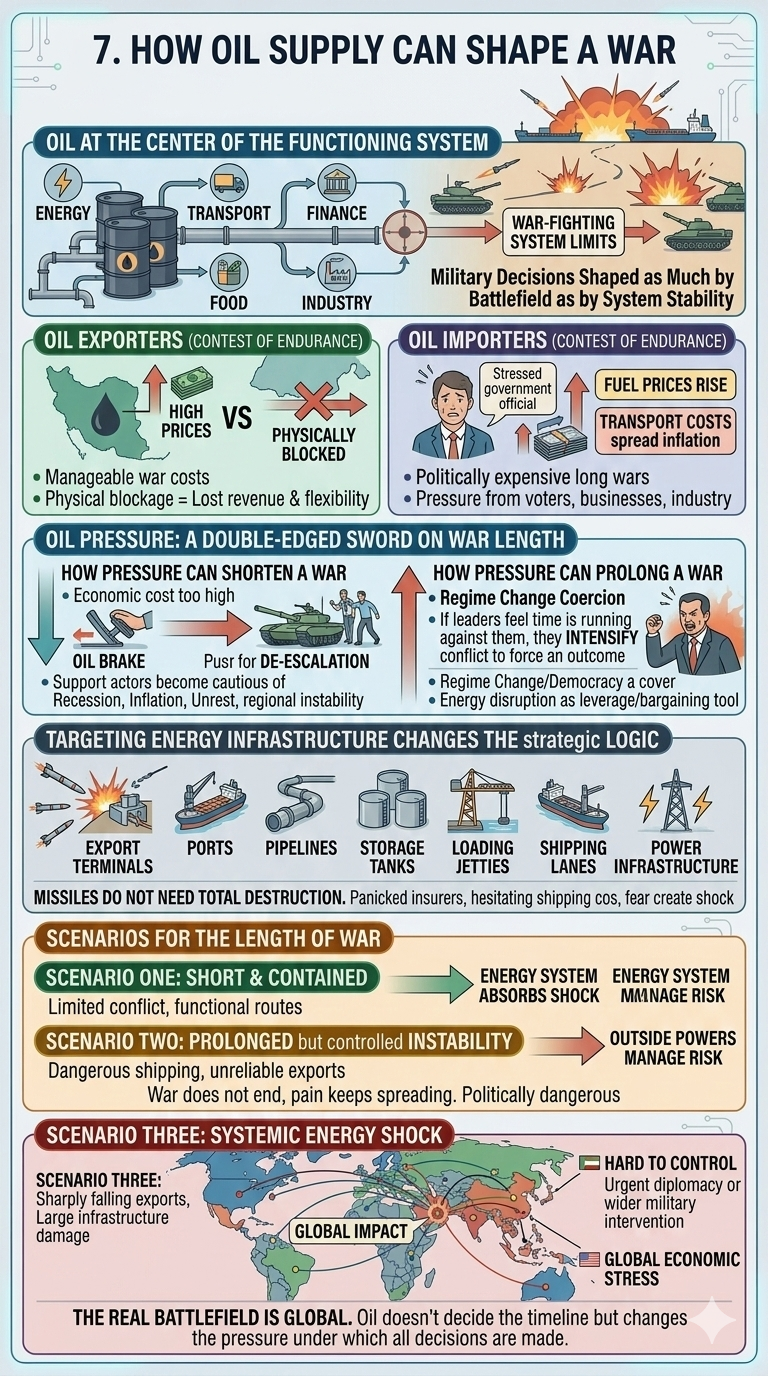
When people think about war, they usually think first about armies, missiles, borders, and political leaders. But wars are not fought by weapons alone. They are also fought by systems that keep states functioning: energy, transport, finance, food, and industry.
Oil sits at the center of that system.
This means that in a major conflict, oil is never just background. It can influence the duration of the war, the cost of the war, and the political limits of the war. To put it simply: if the oil system becomes unstable enough, it can begin to shape military decisions just as much as battlefield events do.
Oil affects how much economic pain states can tolerate
A war is not only a military contest. It is also a contest of endurance. A government can continue a war only as long as it can absorb enough economic pressure without losing internal stability. That pressure can come from many directions:
- falling state revenue
- rising energy prices
- disruption of exports
- inflation
- supply shortages
- public anger
- industrial slowdown
Oil matters here in two opposite ways.
For oil exporters: If an oil-exporting state can still sell oil at high prices, war may become more financially manageable. Higher prices can partly compensate for lower export volumes.
But if exports are physically blocked, the state can lose both revenue and flexibility.
For oil importers: A long war-related oil shock can become politically expensive. Fuel prices rise, transport costs rise, inflation spreads, and governments face pressure from voters, businesses, and industry.
So oil can affect not only the state under attack, but also the states supporting, financing, or enabling the war.
Oil shocks can shorten wars, but they can also prolong them
This sounds contradictory, but both are true.
- How oil pressure can shorten a war (what mostly is expected):
If the economic cost of disruption becomes too high, outside actors may push harder for de-escalation. States that might otherwise support a prolonged military campaign can become more cautious if they fear:
- recession
- inflation
- public unrest
- damage to shipping and trade
- broader regional instability
In this sense, oil can act as a brake. It raises the price of escalation.
- How oil pressure can prolong a war:
The opposite can also happen. If leaders believe that time is running against them, they may try to intensify the war quickly in order to force an outcome before the economic system deteriorates further. (This worth deep thinking in order to understand regime change, democracy and such are just a cover)
Also, if one side believes that energy disruption gives it leverage, it may use that disruption as a bargaining tool rather than stepping back from conflict. So oil pressure does not automatically produce peace. Sometimes it produces urgency, coercion, and riskier decisions.
Energy infrastructure changes the logic of war
Once energy infrastructure enters the picture, the war is no longer only about military targets. Then the strategic map changes.
Targets may include:
- export terminals
- ports
- pipelines
- storage tanks
- processing facilities
- shipping lanes
- loading jetties
- power infrastructure linked to production
This matters because attacks on oil infrastructure can create effects far larger than their immediate physical damage. A missile does not need to destroy an entire oil industry to create a major shock. Sometimes it is enough to make insurers panic, shipping companies hesitate, or traders fear that more attacks are coming.
This makes energy systems highly sensitive in wartime. Their physical vulnerability is only one part of the story. Their psychological and financial vulnerability is often just as important.
Wars are limited not only by weapons, but by system tolerance
On the other hand, every war has practical limits. Not just moral limits (which often do not exist), and not just military limits, but system limits.
A state can mobilize weapons and manpower, but it still needs fuel, electricity, transport, foreign exchange, industrial output and public order. If oil disruption begins to threaten these wider systems, decision-makers may discover that the war is becoming harder to sustain than they expected.
This is particularly important in a region like the Persian Gulf, because the consequences do not remain local. They spread outward through:
- global oil markets
- shipping insurance
- inflation
- manufacturing costs
- food transport
- aviation
- petrochemical chains
That means the real “battlefield” becomes much larger than the territory where bombs are falling.
What this can mean for the length of the war
A war connected to the oil system can develop in several different directions.
Scenario one: short and contained conflict
If the conflict remains geographically limited, export routes remain mostly functional, and oil infrastructure is not seriously damaged, then the energy system may absorb the shock. In this case, the war can remain relatively short because outside powers still have room to manage risk.
Scenario two: prolonged but controlled instability
If shipping remains dangerous, exports become unreliable, and oil prices remain elevated, but total collapse is avoided, then the war may settle into a prolonged unstable phase. This is often politically dangerous because the war does not end, yet the pain keeps spreading.
Scenario three: systemic energy shock
If exports fall sharply, infrastructure damage grows, and maritime routes become effectively unusable, then the war may become much harder to control. Outside actors may be pushed either toward urgent diplomacy or toward wider military intervention. At that point, the duration of the war becomes less predictable, because the conflict is no longer being shaped only by military goals, but also by global economic stress.
So the effect of oil on war length is not mechanical. Oil does not decide the timeline by itself. But it changes the pressure under which all political actors are making decisions.
8. What This Means for Ordinary People
This is the most important part of this essay and what I am trying to say. When people hear discussions about oil, supply chains, strategic chokepoints, and energy markets, the language can sound abstract. It can feel far away from ordinary life. But for individuals, energy crises are never abstract for long. They appear in daily life very quickly.
The first effect is usually price
The most visible impact is often higher prices. If oil prices rise, the increase spreads through the economy because oil is not used only for cars. It affects:
- transport
- food distribution
- heating
- air travel
- manufactured goods
- plastics
- fertilizers
- logistics in general
So even people who never think about oil markets begin to feel the effects through ordinary expenses. A war-related oil shock can therefore become part of daily life through:
- more expensive groceries
- more expensive commuting
- higher utility bills
- higher prices for travel and deliveries
Inflation is not just a number
When economists talk about inflation, the discussion often sounds statistical. But for individuals, inflation means something very concrete:
- your salary buys less
- planning becomes harder
- financial stress rises
- small shocks become harder to absorb
This matters especially for people who are already economically fragile.
Middle-class households may feel squeezed. Poorer households may be pushed into real hardship. And in countries already under sanctions, crisis, or war conditions, the damage is often much worse.
Psychological insecurity also spreads
A war linked to energy systems does not only affect wallets. It also affects people’s sense of stability. When fuel prices rise, goods become uncertain, and headlines constantly mention escalation, ordinary people begin to feel that the world is less predictable. That feeling matters. People may begin to:
- stockpile essentials
- reduce travel
- postpone plans
- fear job losses
- feel trapped in a future they cannot control
So the impact is not only material. It is emotional and psychological too.
The burden is uneven
Like most crises, an energy shock does not hurt everyone equally. Those with money, mobility, savings, and international options are often better protected. Those with lower incomes, insecure jobs, weak currencies, or unstable governments are hit much harder.
And inside war zones, of course, the burden is far worse still. There the question is no longer only price, but survival itself:
- access to fuel
- access to electricity
- hospital functioning
- food transport
- evacuation capacity
So when we talk about energy as a strategic issue, we should not forget that in real life it becomes a question of who can still live with dignity and who cannot.
So, No to War is not merely the moral stance of intellectuals in their lush libraries; it is an essential human objective.
Why this matters politically?
One of the most dangerous illusions in wartime is the belief that energy disruption is just a technical side effect.
It is not.
It can become one of the main ways war enters civilian life, including for people far from the front. That is why oil matters politically. Not because markets are more important than human life, but because disruptions in oil and energy are one of the mechanisms through which war expands beyond the battlefield and begins to reorganize civilian life.
In that sense, an oil crisis is never only about oil, rich traders and governments. It is about how deeply war can penetrate society and how the social pressure and activism matters.