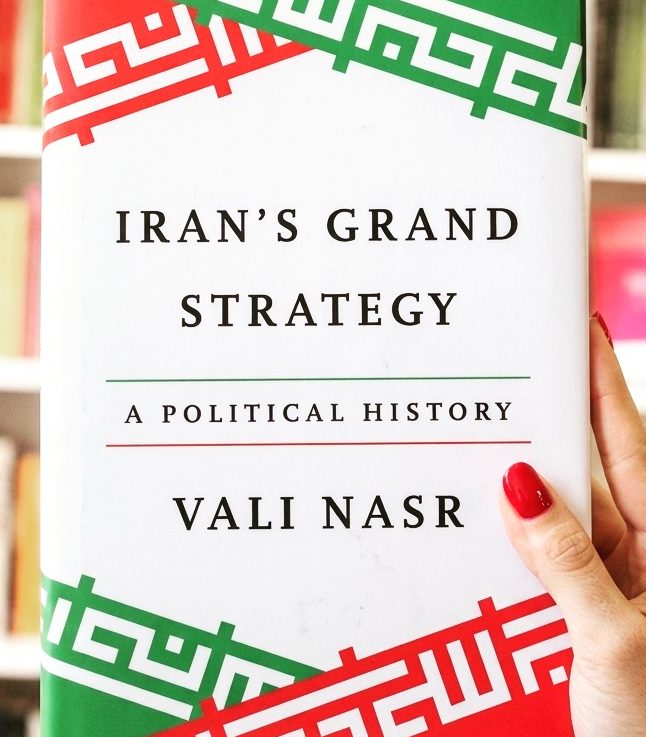
For me, Vali Nasr's "Iran's Grand Strategy" is one of the best books on Iranian foreign policy that I have read in recent years. Its greatest value does not lie in providing the definitive truth about Iran, but rather in guiding the reader away from the familiar media perspective and opening up a different analytical view of the country's behavior.
Nasr attempts to explain Iranian foreign policy neither solely through the lens of ideology nor purely as a reaction to the conflict with the United States. Instead, he analyzes it as the grand strategy of a state. He demonstrates that many decisions made by the Islamic Republic cannot be derived from ideological convictions alone. The experiences of the Iran Iraq War, security policy threat perceptions, deterrence, and the pursuit of state survival have significantly shaped Iranian foreign policy.
This is precisely where both the strength and the limitation of the book lie. Nasr deliberately views Iran as a rational actor. This perspective helps to better understand many foreign policy decisions. At the same time, there is a risk that internal power struggles, ideological factors, or strategic miscalculations are given less weight in places than they actually possess. Nevertheless, his analytical approach remains valuable because it encourages the reader to comprehend the logic of Iranian decision makers before evaluating it.
For me, one of the most important insights of the book was that Iran should not be underestimated as a religiously oriented state. This has nothing to do with approval or disapproval of the Islamic Republic, but rather with analytical rigor. Anyone who automatically considers a political system to be irrational, backward, or incapable of action simply because of its religious or ideological character increases the risk of serious misjudgments. History repeatedly shows that states shaped by ideology or religion can also build highly sophisticated security apparatuses, intelligence services, and military structures.
In my view, part of the Western discourse also unintentionally contributes to the dehumanization of Iran. In the German media and also in political communication, the term "Mullah regime" is frequently used. This expression is less a precise description and more of a political buzzword with a derogatory connotation. Not all key decision makers in Iran are clerics, nor does a religious education automatically imply a lack of competence or intelligence. Above all, however, this term conveys a highly simplified picture of reality.
The actual problem with such terms is not only their derogatory effect, but also that they are analytically misleading. They reduce Iran to a few clerics at the head of state and ignore the complex interplay of state institutions, military and diplomatic structures, economic organizations, and technical expertise. Iran is a country with millions of inhabitants, extensive infrastructure, an established bureaucracy, highly qualified specialists, and decades of experience in keeping a state functional under massive sanction pressure and constant security policy threats. Regardless of who stands at the top of the political system, millions of people work daily in ministries, universities, hospitals, refineries, power plants, industrial enterprises, and transport networks to keep the country running. Ignoring this reality is not only a moral issue, but also a strategic mistake.
As soon as a country is reduced to a caricature, the quality of its analysis also suffers. If Iran is understood merely as a "Mullah regime," the role of state institutions, the bureaucracy, technocrats, security structures, historical experiences, and the technical capabilities of the country fade from view. This can lead to the false assumption that a state like Iran will collapse within a few days. The reality is significantly more complex.
This is precisely where the greatest value of Nasr's book lies for me. It attempts to analyze Iran as it actually is, rather than how it is presented in many media narratives. This by no means implies justifying all decisions or political positions of the Islamic Republic. It merely means wanting to understand the logic of its actions first.
Therefore, the most important insight I took away from this book is that anyone who wishes to understand the behavior of a state must first analyze it as it is, and not as one would like to see it or imagine it. That is exactly why I consider this book so valuable. Not because it delivers the final answer, but because it improves the quality of the questions we ask about Iran and helps us step outside our own media filter bubble.