Too long to read? Listen to it here:
English version
The Sea Blockade and the Sanctions Paradox:
Why "Maximum Pressure" Only Sacrifices the People
Introduction
For over two decades, the Islamic Republic of Iran has existed under the shadow of the world’s most punishing international sanctions regime. Originally designed to compel a change in behavior or trigger a systemic collapse, these measures now face a haunting question: Has this relentless pressure weakened the state’s resolve, or has it simply dismantled the lives of eighty million people?
With the recent addition of a "Sea Blockade" to the equation, the stakes have shifted from economic hardship to a survival crisis. This article dissects the resilience of the Iranian state, the anatomy of the current sanctions, and the devastating human toll of the blockade, illustrating why the current trajectory is no longer a political strategy, but a humanitarian emergency.
1. The Fortress of the State vs. The Erosion of the Home
Contrary to the recurring narrative of an "imminent collapse," Iran’s political structure has proven remarkably durable. By utilizing a "Resistance Economy"—a sophisticated mix of shadow banking, internal patronage, and strict social control—the government has successfully decoupled its own survival from the economic health of its citizens.
However, this institutional resilience is not a sign of success; it is a sign of systemic cannibalism. The state remains standing because the entire weight of the economic war has been shifted onto the shoulders of the ordinary citizen.
The Evaporation of Purchasing Power: Between 2011 and 2020, per capita income bled out at an annual rate of 0.6% against 40% inflation. Today, a skilled laborer’s monthly wage of $227 covers a mere 44% of the $520 required for a family of four to survive above the poverty line.
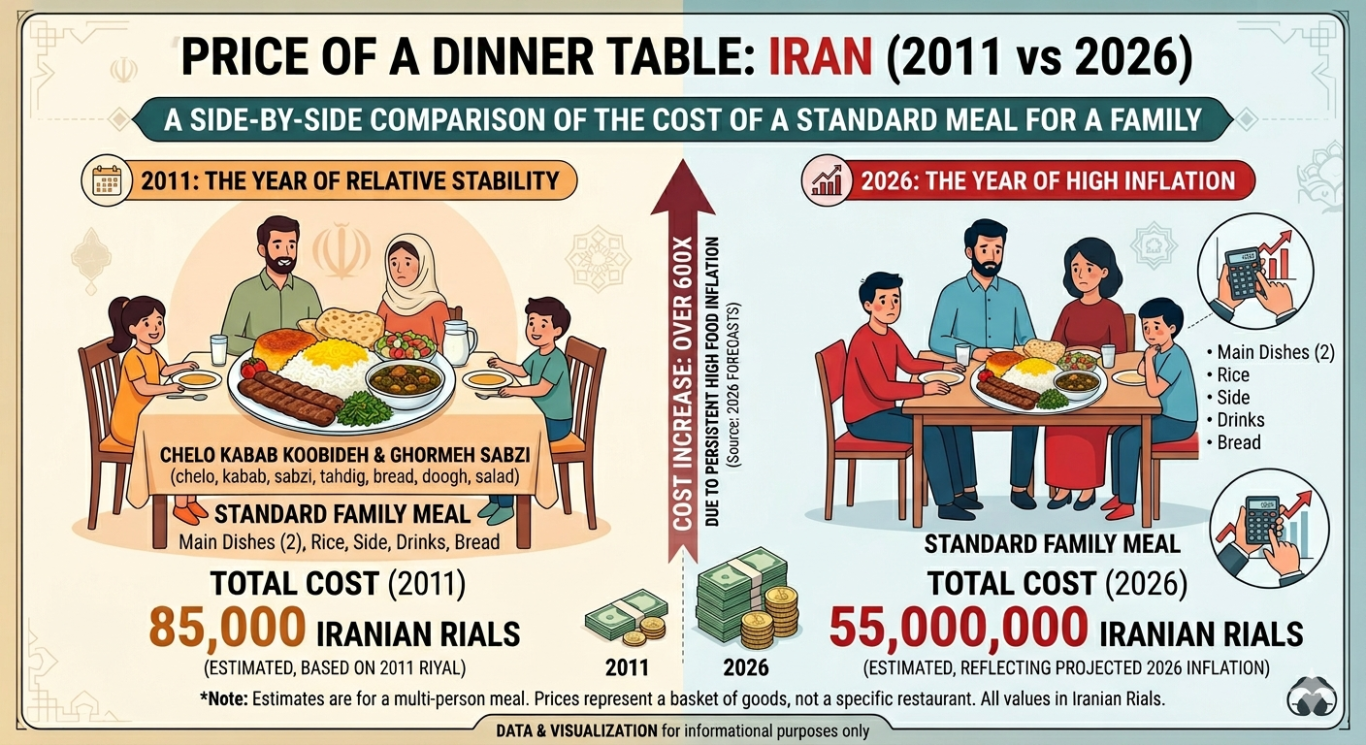
The Hunger Crisis: Even before the blockade, food inflation surged toward 125%. Staples like rice have transformed from daily necessities into luxury goods, their prices quadrupling as families prioritize calories over nutrition.
The Disappearing Middle Class: Once the backbone of Iranian progress, the middle class is undergoing a rapid liquidation, shrinking by 17 percentage points annually between 2012 and 2019.
The Wealth Gap: While 30–40% of households have fallen into poverty, wealth has pooled at the summit; the wealthiest 1% now controls nearly one-third of the nation’s total wealth.
2. Anatomy of the Siege: From UN Resolutions to "Economic Rage"
To understand how policy turns into poverty, one must look at the overlapping layers of the current regime:
Multilateral Sanctions (UN & EU): Following the "Snapback" mechanism in September 2025, all previous UN Security Council resolutions (1737 to 1929) were reinstated. The EU followed suit, freezing Central Bank assets and severing SWIFT access for major banks, effectively paralyzing trade in oil, gas, and precious metals.
Operation "Economic Rage" (USA): Since February 2025, the U.S. has sanctioned over 1,000 individuals and vessels. Their primary target is the "Shadow Fleet"—the 180+ tankers that serve as the state's financial oxygen.
Global Alignment: Countries including Canada, the UK, Australia, and Japan have synchronized their independent sanctions, creating a dense web of financial and logistical isolation that leaves no sector untouched.
3. The Siege of the Interior: How Sanctions Invade Daily Life
Sanctions are often discussed in the abstract, but their mechanical reality is felt at the pharmacy counter and the grocery checkout.
The Financial Heart Attack: Severing Iran from SWIFT has induced a logistical heart attack. Even when medicine is legally "exempt," the pathways to pay for it are blocked. To secure imports, businesses must use shadow brokers who charge exorbitant fees—costs that are ultimately passed down to the starving consumer.
The Silent Death in Hospitals: Patients with MS, cancer, or organ transplants are the direct victims of this financial war. Projections suggest a 50% shortage in critical medications by year-end. For the sick, a "banking delay" is a death sentence.
Industrial Paralysis: The automotive and manufacturing sectors are rusting in real-time due to a lack of electronic components. As factories fall silent, they don't just stop producing goods; they stop producing livelihoods, fueling a cycle of chronic unemployment.
4. The Sea Blockade: A Noose Around the Neck
If the previous twenty years were a slow fever, the Sea Blockade is a violent choking of the nation’s windpipe.
Logistical Chokehold: By inspecting and diverting vessels in the Persian Gulf, the blockade has broken the rhythm of trade. "War Risk" insurance premiums have made it financially suicidal for international shipping lines to dock at Iranian ports.
Acute Protein Insecurity: Iran depends on the sea for the import of corn and soy required to sustain its livestock. When these ships are blocked, the supply chain for meat, poultry, and dairy collapses, leaving the population without basic protein.
The $4.8 Billion Void: The blockade has struck the Kharg Island terminal with surgical precision, depriving the country of nearly $4.8 billion in revenue. To bridge this gap, the state has slashed the last remaining food subsidies, triggering a price explosion that has turned the dinner table into a site of national trauma.
The Spark of Despair: This pressure is pushing a weary population past the point of endurance. While the government survives through black-market ingenuity, the citizen is left to wonder how a policy of starvation is supposed to lead to a more democratic future.
Conclusion: A Call for Humanitarian Sanity
The evidence of the last two decades is overwhelming: the sanctions regime has become a weapon of mass impoverishment. While the government remains insulated behind a wall of "Resistance Economy" tactics and social control, the people have paid with their health, their savings, and their futures.
The Sea Blockade has transformed a political dispute into a full-scale humanitarian emergency. We must now ask: can a hungry, sick, and desperate society ever be the agent of the change the world claims to want? It is time to move beyond the failed logic of "maximum pressure" and take urgent action to save the lives of the millions caught in the crossfire.